
Most traders do not lose money because they have never heard of support and resistance, trend structure, position sizing, or stop losses. They lose because they keep repeating the same small mistakes until those mistakes become expensive habits.
That was the uncomfortable lesson I learned when I started reviewing my trades with AI trading analysis. I thought I already knew my weaknesses. I blamed bad market conditions, weak setups, sudden news, low liquidity, or just “one bad trade.” But when I looked at my trading journal through a more objective lens, the pattern was hard to ignore.
The problem was not one terrible trade. It was a collection of trading mistakes I had normalized.
AI did not magically turn me into a profitable trader. It did something more useful: it showed me what I kept avoiding. It spotted repeated behavior across my trades, highlighted risk management mistakes, and made my emotional trading easier to see. That is where the real value of an AI trading journal begins.
The best trading feedback is not the feedback that makes you feel smart. It is the feedback that shows you what you keep doing when no one is watching.
Why Traders Fail to Notice Their Own Mistakes
Before getting into the five mistakes, it helps to understand why traders repeat the same mistakes even when they know better.
Trading is not only a technical skill. It is also a decision-making environment under pressure. You are dealing with uncertainty, money, ego, time pressure, and emotional consequences. That combination makes honest self-review difficult.
Here are a few reasons traders miss obvious problems in their own behavior:
- Recency bias: One good trade can make you forget five weak ones.
- Outcome bias: If a bad setup wins, you may label it a good decision.
- Emotional memory: You remember the pain of a loss more than the process behind it.
- Lack of structure: Without a proper trading journal, reviews become vague opinions.
- Ego protection: It is easier to blame the market than admit you broke your own plan.
This is where AI for traders can be useful. Not as a prediction machine, but as a review partner. The best way to analyze trading mistakes is to look at actual behavior over time: entries, exits, risk size, trade notes, screenshots, emotional state, setup quality, and rule adherence.
In other words, AI helps traders find mistakes by connecting dots that are easy to miss trade by trade.
Mistake #1: Entering Too Early Because I Wanted to Be “First”
What Traders Do
One of the most common trading mistakes is entering before confirmation. You see price approaching a level, notice volume increasing, or anticipate a breakout. Instead of waiting for your planned signal, you jump in early because you want the best possible entry.
This mistake shows up everywhere: crypto trading mistakes, forex trading mistakes, and stock trading mistakes. The market starts moving, and the trader feels pressure to act before the opportunity disappears.
Why Traders Ignore It
Early entries often feel smart when they work. If you catch the move before everyone else, it reinforces the habit. The problem is that early entries usually come with weaker confirmation, wider uncertainty, and more emotional management.
I used to tell myself, “I was just being aggressive.” But the AI trading journal showed a different story: many of those early entries happened after I had missed a previous setup or after watching price move without me.
How AI Detected It
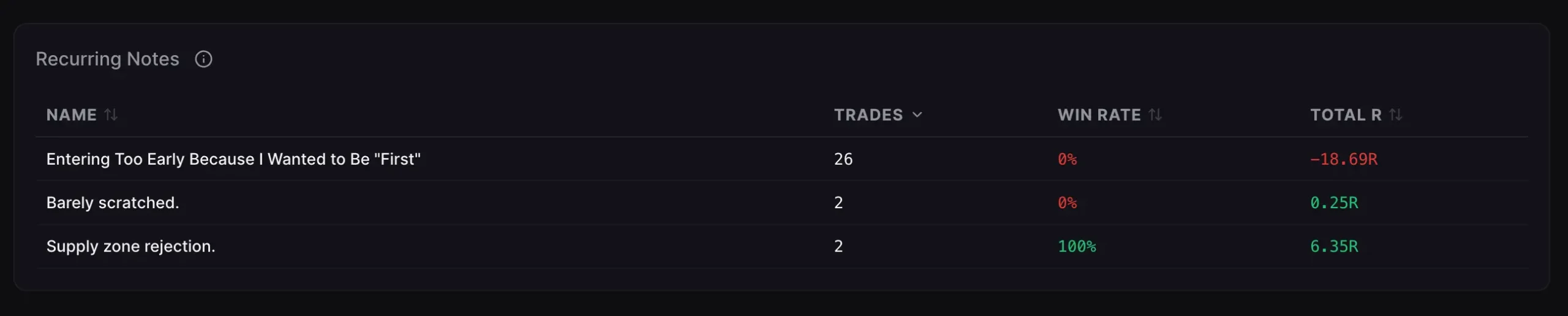
The AI trading analysis compared my written trade notes with the actual timing of my entries. It noticed repeated phrases like “anticipated breakout,” “got in before confirmation,” and “didn’t want to miss it.” It also flagged trades where my entry happened before the setup conditions I had written in my plan.
The pattern was clear: my early entries were not strategy. They were fear of missing out.
How to Fix It
- Define exactly what confirmation means before the session starts.
- Track whether each trade followed the entry rule.
- Separate “valid early entry” from “emotional early entry.”
- Review missed trades without punishing yourself for patience.
Improving this one habit helped my trader discipline more than adding another indicator ever did.
Mistake #2: Moving Stops Because I “Still Believed” in the Trade
What Traders Do
A stop loss is supposed to define the point where the trade idea is invalid. But many traders move their stop farther away once price gets close. They convince themselves the market needs more room, even though the original risk plan has already been broken.
This is one of the most damaging risk management mistakes because it turns a planned loss into an uncontrolled one.
Why Traders Ignore It
Moving a stop does not always feel reckless in the moment. It can feel logical. You see a wick, a liquidity sweep, a retest, or a temporary spike. You tell yourself the setup still looks fine.
But often the real reason is simpler: you do not want to be wrong.
How AI Detected It
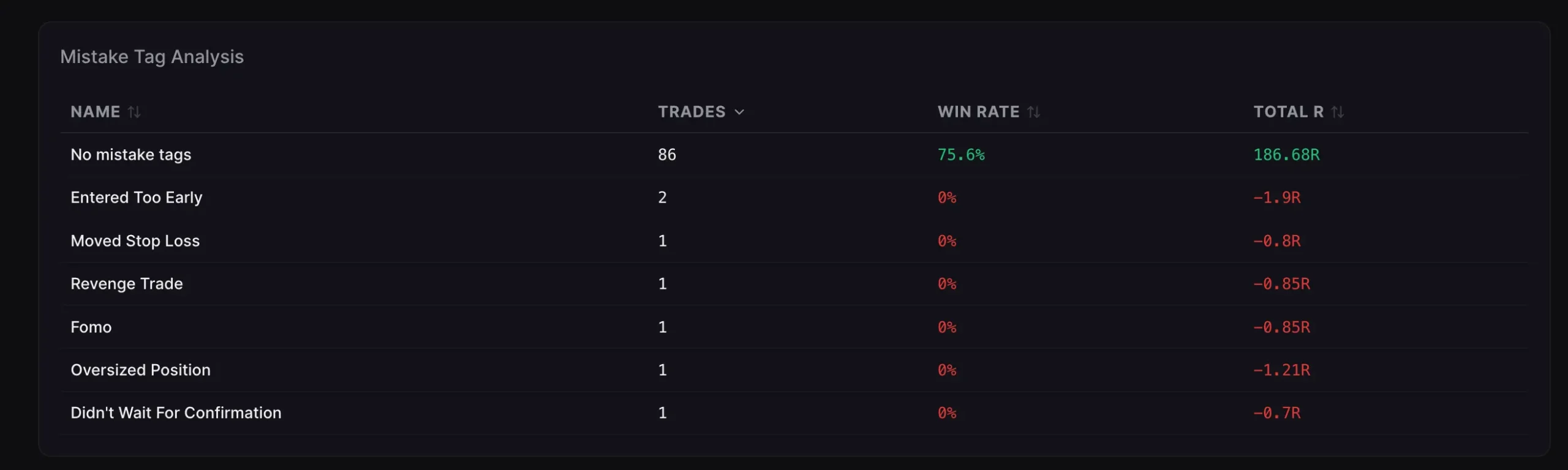
AI caught this by comparing my planned risk with my actual exit. In several trades, the loss was larger than the original risk amount. My notes also had language like “gave it more room” or “wanted to avoid getting wicked out.”
That was useful because it removed the story. I was not adapting. I was refusing to accept invalidation.
How to Fix It
- Write the invalidation point before entering the trade.
- Track planned risk versus actual risk.
- Review every trade where the stop was moved.
- Only adjust stops based on pre-defined rules, not stress.
If you want to improve trading performance, this is one of the first behaviors worth reviewing. A strategy can survive normal losses. It cannot survive emotional risk expansion.
Mistake #3: Taking Low-Quality Trades After a Loss
What Traders Do
After a losing trade, many traders immediately look for another opportunity. The next trade might not match the plan, but it feels necessary. You want to recover. You want to erase the loss. You want to prove the day is not over.
This is revenge trading in a quieter form. It does not always look dramatic. Sometimes it looks like “just one more setup.”
Why Traders Ignore It
The tricky part is that revenge trades can look similar to normal trades. You may still use an indicator, mark a level, or find a technical reason to enter. But the emotional driver is different.
This is where trading psychology matters. The same setup taken calmly and taken impulsively are not always the same trade.
How AI Detected It
The AI trading journal noticed that my second trade after a loss had a lower quality score than my first trade of the session. It also detected repeated patterns in my notes: “trying to make it back,” “quick scalp,” “small recovery trade,” and “could still end green.”
That was a direct answer to how AI helps traders find mistakes: it connected emotional context with trade quality.
How to Fix It
- Add a cooldown rule after losses.
- Rate setup quality before taking the trade.
- Track trades taken within 10 to 30 minutes after a loss.
- Review whether the next trade followed the same standards as the first.
The goal is not to avoid trading after a loss forever. The goal is to know whether the next trade is coming from your plan or your frustration.
Mistake #4: Overtrading During Choppy Market Conditions
What Traders Do
Some market conditions are not friendly to your strategy. Price chops around, breaks levels and reverses, or moves without clean follow-through. Instead of stepping back, traders keep forcing setups.
This is one of the most common trading mistakes because it feels productive. You are active. You are watching the chart. You are trying. But more trades do not always mean better trading.
Why Traders Ignore It
Overtrading often hides behind effort. If you spend hours at the screen, it feels wasteful to do nothing. That pressure can make you lower your standards.
For day traders, especially in crypto and forex, 24-hour markets can make this worse. There is always another candle. Always another pair. Always another reason to click.
How AI Detected It
AI noticed that my worst sessions often had more trades than my best sessions. It also found that my win rate dropped when I took multiple trades in low-volatility or range-bound conditions.
The insight was not “trade less” in a generic way. It was more specific: I performed worse when I traded my trend-following setup in sideways markets.
How to Fix It
- Tag market conditions in your trading journal.
- Track performance by trend, range, volatility, and session time.
- Create a maximum number of trades per session.
- Define what a “no trade” environment looks like.
This is a practical example of how to improve trading using AI. The AI does not need to predict the next move. It only needs to help you identify where your strategy performs poorly.
Mistake #5: Ignoring the Difference Between a Good Trade and a Winning Trade
What Traders Do
A winning trade can be a bad trade. A losing trade can be a good trade. Most traders understand this in theory, but they do not review their trades that way.
If the trade wins, they feel validated. If it loses, they feel wrong. That kind of review creates dangerous feedback because it rewards outcomes instead of process.
Why Traders Ignore It
Money has emotional weight. A profitable trade feels good, even if the entry was late, the stop was random, and the risk was too large. A losing trade feels bad, even if it followed the plan perfectly.
This is why a trading journal matters. Without process-based review, you may train yourself to repeat lucky behavior and abandon disciplined behavior.
How AI Detected It
The AI trading analysis separated my trades by rule adherence, not just profit and loss. Some winning trades had poor discipline scores. Some losing trades had strong execution scores.
That helped answer a question many traders ask: can AI improve trading results? AI can help if you use it to improve decisions, not chase predictions. Better review can lead to better behavior, and better behavior gives your strategy a fairer chance.
How to Fix It
- Grade every trade on execution quality.
- Review winners for bad habits, not just losers.
- Separate setup quality from trade outcome.
- Track whether your best process actually leads to better long-term performance.
Practical Example: Before AI Analysis vs. After AI Insights
Here is a simple example of how the review process changed for me.
| Before AI Analysis | After AI Insights |
|---|---|
| “I had a bad day because the market was choppy.” | “I took six trades in a range even though my strategy performs better in trending conditions.” |
| “I got stopped out unfairly.” | “I entered before confirmation and placed the stop inside normal market noise.” |
| “I need better entries.” | “My entries are weakest after I miss the first move of the session.” |
| “I need more discipline.” | “My discipline drops after a loss, especially within the next 20 minutes.” |
The important shift was from vague self-criticism to specific behavioral feedback. That is the best way to analyze trading mistakes: use real trading data, identify repeated patterns, and turn them into rules you can actually follow.
How AI Helps Traders Build Better Habits
Better trading habits come from better feedback. If your review process is inconsistent, your improvement will be inconsistent too.
An AI trading journal can help traders build better habits by making review more structured. It can summarize your trades, find recurring behavior, detect emotional language in notes, and show where your process breaks down.
Useful habit-building areas include:
- Entry discipline: Did you wait for your planned confirmation?
- Risk control: Did you respect your stop and position size?
- Emotional awareness: Were you trading from patience, fear, anger, or urgency?
- Setup quality: Did the trade match your actual strategy?
- Session review: Did your performance change by time of day or market condition?
For traders who struggle with emotional trading, this kind of review can be uncomfortable at first. But it is useful discomfort. The goal is not to judge yourself. The goal is to understand your trading behavior clearly enough to change it.
How to Use Trading Data to Improve Your Strategy
Many traders collect data but never turn it into decisions. They log entries, exits, and screenshots, then rarely review them deeply. A trading journal only becomes valuable when it helps you make better choices.
To analyze trading performance in a practical way, focus on questions that lead to action:
- Which setup performs best for me?
- Which market conditions hurt my results?
- What happens after I take a loss?
- Do I perform better during certain sessions?
- Are my biggest losses caused by strategy failure or rule-breaking?
- Which trading habits show up before my worst trades?
This is where trading with artificial intelligence becomes helpful. AI can organize messy trade data into clearer insights. It can review your notes, compare planned behavior against actual behavior, and help you see patterns faster than manual review alone.
Still, AI should not replace your judgment. It should support it. You are the trader. You decide which insights matter, which rules to adjust, and how to apply the feedback in live markets.
Featured Answer: What Are AI Trading Mistakes?
AI trading mistakes are trading errors that become easier to spot when artificial intelligence reviews your trade history, journal notes, screenshots, and performance patterns. These may include emotional entries, poor risk management, overtrading, revenge trading, early exits, and repeated rule-breaking.
AI does not need to predict the market to be useful. It can help traders improve by showing them where their behavior and strategy are out of alignment.
FAQ
How AI helps traders find mistakes?
AI helps traders find mistakes by analyzing trade history, journal notes, risk data, and repeated behavior. It can detect patterns such as entering too early, moving stops, overtrading after losses, or performing poorly in certain market conditions.
How to improve trading using AI?
Use AI to review your completed trades, not to blindly follow signals. The most practical approach is to log trades in an AI trading journal, review recurring mistakes, track execution quality, and adjust your rules based on real performance data.
Why traders repeat the same mistakes?
Traders repeat the same mistakes because emotions, bias, and poor review habits make patterns hard to see. Fear of missing out, frustration after losses, and overconfidence after wins can cause traders to break rules even when they know better.
What is the best way to analyze trading mistakes?
The best way to analyze trading mistakes is to review both data and behavior. Look at entry timing, exit quality, risk size, market condition, emotional state, and whether the trade followed your plan. A structured trading journal makes this process much easier.
Can AI improve trading results?
AI can help improve trading results indirectly by improving review quality, discipline, and decision-making. It cannot guarantee profits or remove market risk, but it can help traders identify harmful patterns and build better trading habits.
Final Thoughts: The Mistakes You Ignore Are Usually the Ones That Matter
The hardest trading mistakes to fix are not always the obvious ones. They are the ones that feel normal. The early entry that almost worked. The moved stop that “made sense.” The extra trade after a loss. The overtrading session you called hard work. The lucky winner you treated like proof.
That is why objective review matters. When you use a trading journal consistently, especially one supported by AI trading analysis, you give yourself a clearer mirror. You stop relying only on memory and start reviewing what actually happened.
If you want to understand your trading behavior, review your trades more honestly, and improve decision-making over time, try using TradeDoctorAI as your AI trading journal. Upload or log your trades, study your patterns, and let the data show you what your emotions may be hiding.
Better trading does not start with knowing everything. It starts with finally seeing the mistakes you kept explaining away.