
Swing trading journals fail for a different reason than day trading ones. Day traders drown in volume. Swing traders have the opposite problem: a trade lasts days or weeks, and by the time it closes you have forgotten why you opened it. The fix is to write down the thinking at three moments, not at one.
Moment one: the entry note (3 minutes)
Write this before or right after you enter, while the reasoning is fresh:
- The setup, in a sentence, and the higher timeframe context
- Entry, stop and first target, with planned risk as a number
- What would make you exit early, besides the stop (a close below a level, news, a sector turning)
- Screenshot of the daily chart
The second bullet is the one that saves you later. A written invalidation condition is much harder to rationalize away at day six than a vague intention.
Moment two: a short check-in during the trade
Once a day or once every few days, add one line: still valid, weaker, or invalid, and why. Skip the price commentary. You are testing whether your thesis is intact, not narrating the chart.
This also exposes a common swing trade habit, which is changing the story to avoid taking a loss. If your check-ins say "weaker" for four days in a row and you are still holding, that is worth seeing written down.
Moment three: the exit review (5 minutes)
Result in R, how it ended (target, stop, time exit, discretionary), and whether you followed the plan. Add a number most swing journals miss: how many days the trade took.
Time in the trade changes the math
Compare two trades:
| Trade | Result | Days held | R per day |
|---|---|---|---|
| A | +3.0R | 12 | 0.25R |
| B | +1.5R | 3 | 0.50R |
Trade A made twice as much and ran four times as long. Capital sitting in a slow trade is not available for another one. If you have a pile of A-style trades and your account is barely moving, check average holding time next to average R. It is not a perfect metric, since overlapping positions complicate it, but it points at where time is going.
Costs that day traders ignore
- Overnight financing or swap fees. On leveraged products they accumulate every night. Include them in the net result.
- Gaps. Over a weekend, price can jump past your stop. Note the gap loss separately from ordinary stop losses, so you can see how often it happens and size accordingly.
- Event risk. Earnings, central bank decisions, elections. Tag trades that were open through a major event.
A weekly rhythm that fits swing trading
- Weekend: review open trades against their written invalidation levels. Plan the week’s candidates.
- Weekdays: a two-minute check on each open position, no more.
- When a trade closes: the exit review, the same day.
- Monthly: look at results by setup, holding time and mistake tag. With fewer trades than a day trader, you need several months before patterns mean much. Four trades a month is 48 a year, so be patient and don’t over-read a quarter.
Tooling
A spreadsheet with a notes column is enough for a swing trader doing a handful of trades a month. If you also trade lower timeframes, or run several accounts, TradeDoctor AI can import your statements and give you strategy-level expectancy and drawdown, with screenshots attached via Snap Journal and AI trade reviews on each closed trade. Free covers 50 trades, which for a swing trader is often more than a year of history.
More on the discipline side: how to start a trading journal, journaling in five minutes a day, and what drawdown means.
A worked example: a five-day swing trade
A trader buys a stock at $50.00 with a stop at $47.50, so 1R is $2.50 per share. Her entry note says the setup is a pullback to the 20-day average in an uptrend, the plan is to hold up to ten days, and the target is $55 (2R). On day two the price is $50.40 and the check-in note records “no change in thesis”. On day four, earnings for a related company are announced and the stock drops to $48.60. The check-in asks one question: is the original reason still valid? She decides the trend is intact, the stop has not been hit, and she holds.
On day six the stock exits at $52.70 on a trailing rule, +1.08R. In the exit review she notes that she nearly sold on day four because of the news, which would have produced a -0.56R loss. That note, repeated over several trades, shows how often anxiety about news causes an exit that the plan did not call for.
Overnight and weekend risk in your notes
Day traders do not carry gap risk. Swing traders do. Add a line in the entry note about known events before the planned exit: earnings dates, central bank meetings, index rebalances. If you chose to hold through one, record that it was a decision. If a gap through your stop produces a loss greater than 1R, record the actual R, because the realized average will be worse than the planned one and your expectancy should reflect that.
What to review after 20 swing trades
- Average holding time for winners versus losers. Holding losers longer than winners is a common pattern.
- Percentage of trades exited by the plan versus exited early on a feeling.
- Average R by setup, as in our expectancy guide.
- How many trades hit the time limit without moving, which means capital was tied up for little.
Swing traders produce fewer trades than day traders, so samples build slowly. Twenty trades might take three or four months. That is a reason to record the qualitative notes carefully, since each trade carries more of the information you have.
Using a journal tool for swing trades
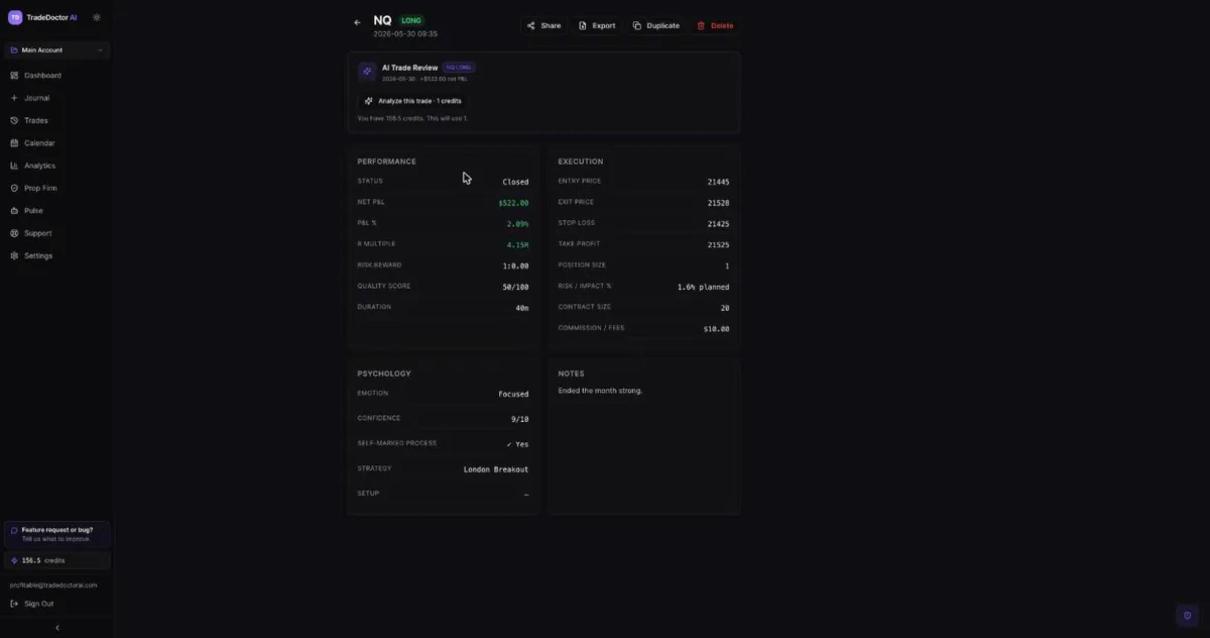
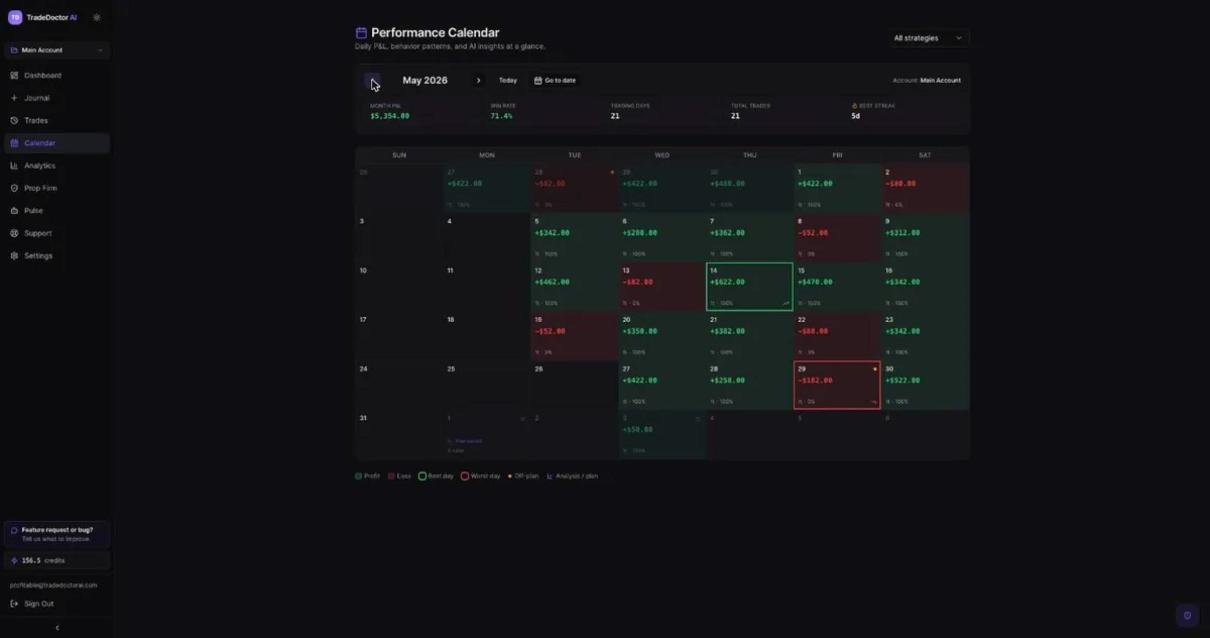
In TradeDoctor AI, the trade detail page holds the entry reasoning and the execution and psychology notes, the trade history shows each trade’s R-multiple, and the performance calendar shows the result by day. Because swing trades span several days, the result lands on the closing day. The Pulse coach can be asked about patterns in your own notes, such as which setups you tend to exit early. It does not have specific swing trading workflows, so the holding-period and event notes are things you add yourself.
Frequently Asked Questions
How often should a swing trader update their journal?
At entry, briefly while the trade is open, and at exit. A weekly review ties it together.
What should I track that day traders don’t?
Holding time, overnight costs, gap events, and whether the thesis was still valid at each check-in.
How many trades do I need before drawing conclusions?
For swing trading, 30 trades from one setup is still the target, and it may take most of a year. Until then, focus on rule-following rather than results.
Should I journal trades I decided not to take?
Yes, briefly. It tells you whether your filters are working.