
Maximum adverse excursion (MAE) is the furthest a trade moved against you before it closed. If you buy at 1.1000, price dips to 1.0980 and then rallies to your target, the MAE on that trade is 20 pips, even though you finished in profit. It is a record of how much pain a winning trade actually asked you to sit through.
What MAE is useful for
One job, mainly: checking whether your stop is in the right place. A stop that is too tight cuts trades that would have worked. A stop that is too wide risks more than the setup needs. MAE data from your own winners shows where that line sits for your strategy.
A worked example
Suppose your stop is 20 pips and you collect the MAE for ten winning trades:
| Trade | 1 | 2 | 3 | 4 | 5 | 6 | 7 | 8 | 9 | 10 |
|---|---|---|---|---|---|---|---|---|---|---|
| MAE (pips) | 4 | 6 | 3 | 9 | 5 | 12 | 2 | 7 | 14 | 5 |
Eight of the ten winners never went more than 9 pips against you. Two went to 12 and 14. If you had used a 10-pip stop, trades 6 and 9 would have been stopped out, a 20% cut to your winners, in exchange for risking half as much on each trade. Whether that is a good deal depends on the next piece of data, and this is where most explanations of MAE stop too early.
The catch: losers have no useful MAE
Every losing trade that hits its stop has an MAE equal to the stop distance. So a plot of loser MAE tells you nothing. The question you really need answered is how many of the trades that would have reached 20 pips against you eventually turned around. You can only learn that from trades where you did not use a hard stop (a demo, a backtest, or a period where you moved a stop and got lucky). Be skeptical of any chart that claims a perfect stop level from winners alone. It is survivorship bias in a nice layout.
How to record MAE without special software
- After the trade closes, open the chart and find the worst price between your entry and exit.
- Measure the distance from entry in pips, points or R.
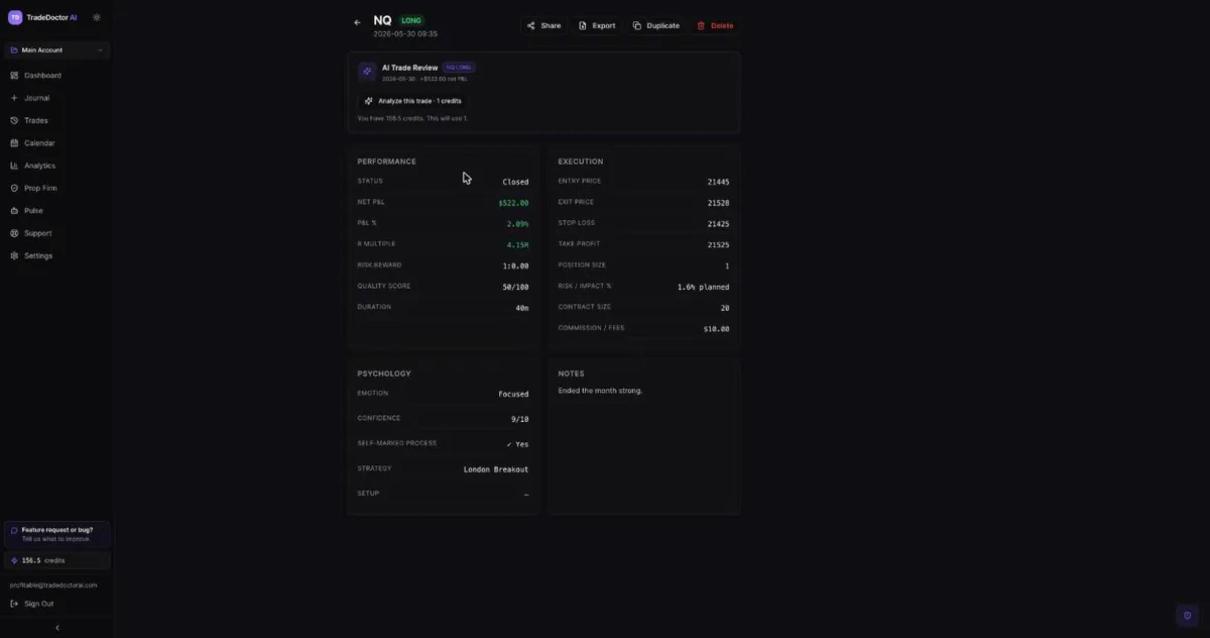
- Write it next to the trade. In TradeDoctor AI the notes field works; so does a spreadsheet column.
Honest caveat: TradeDoctor AI does not currently compute MAE or MFE automatically, because most broker statements do not include the intratrade extremes. If you want that data without doing it by hand, you will need a platform that stores tick or bar history against each trade.
Using R instead of pips
Express MAE as a fraction of your planned risk. A trade that went 9 pips against a 20-pip stop has an MAE of 0.45R. Now you can combine EUR/USD and gold trades in one analysis. If most of your winners have MAE below 0.5R, your entries are probably well timed, and your stop is mostly doing the job of insurance rather than giving the trade room.
What not to do with it
- Do not tighten a stop because the last five winners were shallow. Use at least 30 winners.
- Do not compare MAE across different setups without separating them. A breakout and a mean-reversion trade have very different normal drawdowns.
- Do not use it to justify moving a stop mid-trade. The point is to set the stop before entry, with evidence.
For how stop placement ties into position size, our risk-reward ratio guide and trade review walkthrough are good companions.
Reading MAE across a batch of trades
A single trade’s MAE tells you little. The pattern across thirty or forty trades is where it earns its place. Build a simple table with two columns: MAE in R, and the final result in R. Then sort the winners by MAE.
If 90% of your winning trades never went further against you than -0.5R, while your stop sits at -1R, you are holding half of your risk budget in a zone that winning trades almost never visit. That suggests a tighter stop could keep nearly the same winners at a smaller cost per loser. If instead several of your winners went to -0.9R before reversing, tightening the stop would have turned them into losses, and the current stop is doing real work.
Always check the other side: how many of your losers would a tighter stop have saved money on? A tighter stop reduces the loss on trades that were going to fail, but it also stops out winners that dipped first. The only way to know the net effect is to look at both groups together.
A second worked example: the stop that was too tight
Suppose a trader scalps with a 6-pip stop and has recorded MAE on 35 winners. Looking at the data, 14 of the 35 winners went 4 to 5.5 pips against her before moving in her favor. The stop looks tight in the sense that it sits very near the noise level of the pair at that time of day. Her win rate is 38%, and when she widens the stop in her plan to 9 pips while halving the position size to keep risk constant, she can test whether those 14 trades would have survived. If so, her win rate rises, but the target in pips must also stay realistic or the reward-to-risk deteriorates.
This is the point of MAE: it turns “my stops feel too tight” into a question you can answer with your own trades. It does not tell you the answer in advance, and a sample this small should be treated as a hypothesis to test on the next 30 trades.
Where MAE fits in a review
Add MAE as one field in your post-trade note, next to the reason for entry and the mistake tag. When you do the weekly review, scan for trades where the MAE was close to the full stop, then ask whether the entry was late or early. Poor entries often show up as trades that start heavily underwater. Good entries, in contrast, tend to move in your favor quickly, with a small MAE.
TradeDoctor AI lets you record execution and psychology notes on each trade and tag mistakes during review, so you can write your MAE reading in the trade notes and filter for the tagged trades later. It does not calculate MAE automatically at present, so the number comes from your chart or platform, as described above.
For the broader process, see our guides on doing a proper trade review and what to write in your journal.
Frequently Asked Questions
What is MAE in trading?
Maximum adverse excursion is the largest unrealized loss a trade showed between entry and exit. It is measured in pips, points, currency or R.
How is MAE different from drawdown?
Drawdown is measured on the whole account’s equity curve. MAE is measured on a single trade.
How many trades do I need for MAE analysis?
At least 30 winning trades from the same setup. Fewer than that and a single odd trade can change your conclusion.
Can I use MAE on discretionary trades?
Yes, as long as you define your planned stop before entry. Without that, there is nothing to compare the MAE against.