
Maximum favorable excursion (MFE) is the best open profit a trade showed before you closed it. Buy at 2,300, watch gold touch 2,330, close at 2,315, and your MFE is 30 points while your result is 15. The gap between those two numbers is what this metric is for.
Audit your exits with ten winners
Take ten winning trades and record two values for each, in R: where you exited, and the best point reached.
| # | Exit (R) | MFE (R) | Captured |
|---|---|---|---|
| 1 | 1.0 | 2.2 | 45% |
| 2 | 1.5 | 1.8 | 83% |
| 3 | 0.8 | 2.6 | 31% |
| 4 | 2.0 | 2.4 | 83% |
| 5 | 1.2 | 3.0 | 40% |
| 6 | 1.0 | 1.2 | 83% |
| 7 | 2.5 | 3.1 | 81% |
| 8 | 0.9 | 2.0 | 45% |
| 9 | 1.5 | 1.6 | 94% |
| 10 | 1.1 | 2.8 | 39% |
Total taken: 13.5R. Total available: 22.7R. You kept about 59% of the best moves. The remaining 9.2R is the pile of "what if" sitting between your exit and the peak.
Trades 3, 5 and 10 are the interesting ones. Each reached at least 2.6R and was closed at 0.8 to 1.2R. Pull up those charts. Was there a plan to exit there, or did a pullback make you nervous? Your journal notes from the moment of the exit will answer that better than the chart will.
Do not chase 100%
You will never capture every peak, because you only know the high in hindsight. A capture ratio of 50% to 70% on trend-following trades is normal. Scalpers who take quick targets will sit lower on this metric by design and should care less about it.
Testing an exit rule against your own data
Here is a more useful question than "how much did I leave behind": would a simple rule have done better? Try a fixed 1.5R target on the same ten trades. Nine of them reached at least 1.5R (everything except trade 6, which peaked at 1.2). Exit all nine at 1.5R and keep trade 6 at its actual 1.0R: that is 13.5 + 1.0 = 14.5R, against 13.5R actual. A one-R improvement over ten trades, from a rule you could have written down in advance.
Now the part people skip. This sample only includes winners. A fixed target also affects losers: some losing trades were up 1R or more before reversing, and a target would have turned those into wins. Check their MFE too, since that is where an exit rule has the most to give. Looking at winners only gives you half the picture and tends to flatter whatever rule you test.
Three exit styles and what MFE says about each
- Fixed target: If many trades reach the target and then keep going by a lot, the target is too close. If many fall just short, it is too far.
- Trailing stop: A low capture ratio with big MFE usually means the trail is too loose, giving back too much before it triggers.
- Discretionary exit: Low capture on the trades you closed "because it felt like it" is the clearest sign you are exiting on emotion. Tag those as mistakes and count them.
Logging MFE
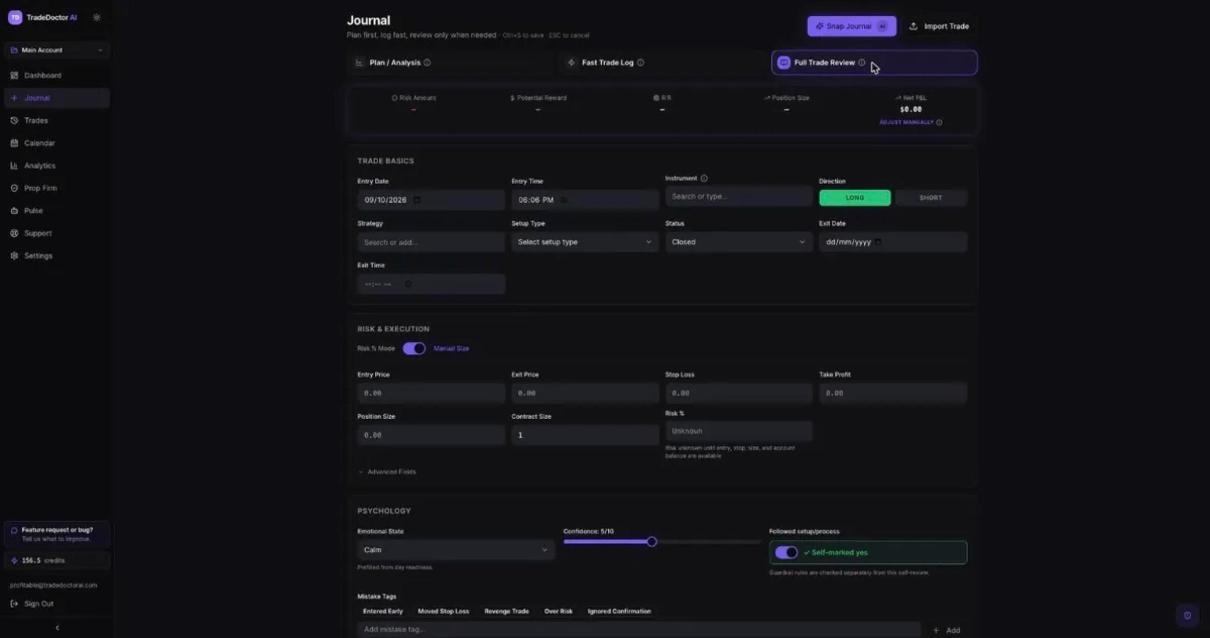
As with adverse excursion, record it after the close by finding the best price between your entry and exit on the chart, and write it in R beside the trade. TradeDoctor AI does not auto-calculate MFE today. What it does give you is a place to tag early exits as a mistake and filter every trade carrying that tag, so you can see how many R those exits cost over a month. Pair that with the excursion number you wrote in the notes and the picture gets clear quickly.
Related reading: MAE and stop placement, how to review a trade properly, and logging versus analysing.
Reading MFE alongside MAE
MFE and MAE answer opposite questions about the same trades. MAE asks how much room a trade needed to survive. MFE asks how much profit was on the table before it closed. Reading them together shows the shape of a typical trade: a trade that dips 0.2R and then runs 2R tells a different story from one that sits at +1.5R, drifts back, and exits at +0.3R.
If a large share of your winners reached 1.5R or more but closed under 1R, you are exiting too early, or your target is placed beyond where the price usually gets. If many losers had an MFE above 1R before reversing to a full stop, the issue is not entry quality. It is the absence of a rule for protecting open profit, and a break-even or partial-exit rule is worth testing.
A worked example with losers included
Take 20 trades. Twelve are winners with an average final result of +1.1R and an average MFE of +2.0R. Eight are losers at -1R, but five of those eight had an MFE of at least +1R before turning.
The average winner leaves about 0.9R behind. That is not automatically a mistake, because nobody exits at the exact top. The five losers are the more interesting group: they were at least one full risk unit in profit and ended at a full loss. If a rule had moved the stop to break-even at +1R, some of those would have closed near zero instead of -1R, though a few might also have been stopped out at break-even before going on to win. Check the winners too before adopting the rule: count how many winners went back to entry after touching +1R. If the number is small, the rule helps. If it is large, the rule costs more than it saves.
Mistakes people make with MFE
Treating it as a target. MFE is known only in hindsight. It tells you what the price did, not where it will go next time. Use it to compare rules, not to set a prediction.
Reading it from a handful of trades. Ten trades can show almost anything. Wait for 30 or more per setup before changing a rule.
Mixing setups. A breakout trade and a mean-reversion trade have very different MFE profiles. Averaging them hides both.
Ignoring costs. A rule that takes profit sooner means more trades closed at the spread and commission, and it can lift your win rate while lowering your expectancy. Judge changes in R after costs.
Recording MFE in your journal
The simplest approach is to note the highest R the trade reached in the trade’s notes at the time you review, using the chart. In TradeDoctor AI, the trade detail page has fields for execution and psychology notes, and the full review screen lets you tag mistakes such as exiting early. MFE itself is not calculated automatically, so that number comes from your chart.
After a month, filter the trades tagged as early exits and compare their average R with the rest. If the gap is large, you have a measurable cost for the habit and a reason to change the rule. Our post on risk-reward ratio covers how targets fit into that.
Frequently Asked Questions
What does MFE mean in trading?
Maximum favorable excursion is the largest unrealized profit a trade reached before it was closed.
What is a good capture ratio?
For trend-following and swing trades, 50% to 70% of MFE is typical. Short-term scalping will be lower.
Should I set my take-profit from MFE?
Use it as evidence, not a command. Look at the distribution across at least 30 trades from one setup, and check what happens to losers under the same target.
Is MFE the same as unrealized profit?
It is the peak of unrealized profit during the trade’s life, not the current figure.