
Most traders track the easy numbers first.
Entry price. Exit price. Stop loss. Profit and loss. Win rate. Risk-reward. Those numbers matter, but they do not tell the full story.
A trade is not just a chart decision. It is also a psychological decision. The same setup can be traded calmly, rushed, fearfully, or with revenge in mind. The chart may look similar, but the quality of the decision is completely different.
That is why a trading psychology journal is so useful. It helps you track emotions alongside trades so you can see how fear, greed, boredom, frustration, confidence, and pressure affect your execution.
At TradeDoctorAI, we believe emotional data is trading data. If an emotion changes your entry, exit, position size, stop loss, or trade frequency, it belongs in your journal.
You cannot manage a pattern you refuse to track.
What Is a Trading Psychology Journal?
A trading psychology journal is a trading journal that records your emotional state before, during, and after each trade.
It does not replace your normal trade journal. It adds context to it.
A standard journal may show:
- What you traded
- Where you entered
- Where you exited
- How much you made or lost
A psychology journal helps explain:
- Why you entered early
- Why you closed a winner too soon
- Why you moved your stop
- Why you took another trade after a loss
- Why you traded a setup that was not in your plan
This is where real trading psychology becomes practical. You are not just saying, “I need more discipline.” You are identifying the emotional triggers that cause discipline to break.
Why Emotions Matter in Trading Performance
Every trader has emotions. The goal is not to remove them. The goal is to stop emotions from quietly controlling your decisions.
Common emotional trading patterns include:
- Fear: Exiting winners too early or skipping valid setups
- Greed: Holding too long or increasing size without a plan
- Frustration: Revenge trading after losses
- Boredom: Taking low-quality trades in slow markets
- Overconfidence: Oversizing after a winning streak
- FOMO: Chasing late entries after missing the first move
- Hope: Holding losing trades beyond invalidation
These emotions can affect your results more than the setup itself.
For example, two traders may take the same breakout. One waits for confirmation, uses planned risk, and exits according to rules. The other chases late, uses too much size, and closes early from fear. Same market. Different psychology. Different outcome over time.
What to Track in a Trading Psychology Journal
You do not need to write a long emotional essay after every trade. Keep it simple and consistent.
Track these fields inside your TradeDoctorAI journal:
- Emotion before entry: How did you feel before entering?
- Emotion during the trade: What did you feel while the trade was open?
- Emotion after exit: How did the result affect you?
- Trigger: What caused the emotion?
- Behavior: Did the emotion change your decision?
- Rule adherence: Did you follow or break your plan?
- Lesson: What should you repeat or avoid next time?
Step 1: Tag Your Emotion Before Entry
Before entering a trade, pause for a few seconds and choose one emotional tag.
Use simple labels:
- Calm
- Patient
- Confident
- Rushed
- Fearful
- Frustrated
- Bored
- Overconfident
- Revenge-minded
- FOMO
Then write one short sentence if needed.
Example
“Emotion before entry: rushed. I missed the first breakout and felt pressure to catch the next move.”
This small note can become very useful later. If your data shows that “rushed” trades perform poorly, you have a clear behavior to fix.
Step 2: Record the Trigger
An emotion usually has a trigger.
The trigger may be:
- A previous losing trade
- A missed entry
- A strong candle moving without you
- A winning streak
- A slow market
- A daily P&L number
- External stress before the session
Write the trigger as simply as possible.
Example
“Trigger: previous trade stopped out and I wanted to recover quickly.”
Or:
“Trigger: market was slow and I felt bored after watching for 90 minutes.”
When TradeDoctorAI reviews your trades, these triggers help identify patterns behind emotional decisions.
Step 3: Track Whether Emotion Changed the Trade
Feeling emotion is not the problem. Acting from emotion is the problem.
After the trade, ask:
- Did emotion make me enter early?
- Did emotion make me increase size?
- Did emotion make me move the stop?
- Did emotion make me exit early?
- Did emotion make me take a trade outside my plan?
- Did emotion make me keep trading after I should have stopped?
Example
“Emotion changed the trade: yes. I entered before confirmation because I felt FOMO after missing the first move.”
This is the difference between emotional awareness and useful emotional data.
Step 4: Compare Emotion With Trade Quality
Once you have several trades logged, compare emotional state with execution quality.
Look for patterns like:
- Calm trades have better execution scores.
- Frustrated trades lead to larger losses.
- Bored trades happen during low-volume conditions.
- Fearful trades close early before target.
- Overconfident trades use larger size.
- Revenge-minded trades happen within 30 minutes after a loss.
This is where an AI trade review can help. TradeDoctorAI can analyze your notes and tags to show which emotions are connected to your weakest trading decisions.
Step 5: Review Emotional Patterns Weekly
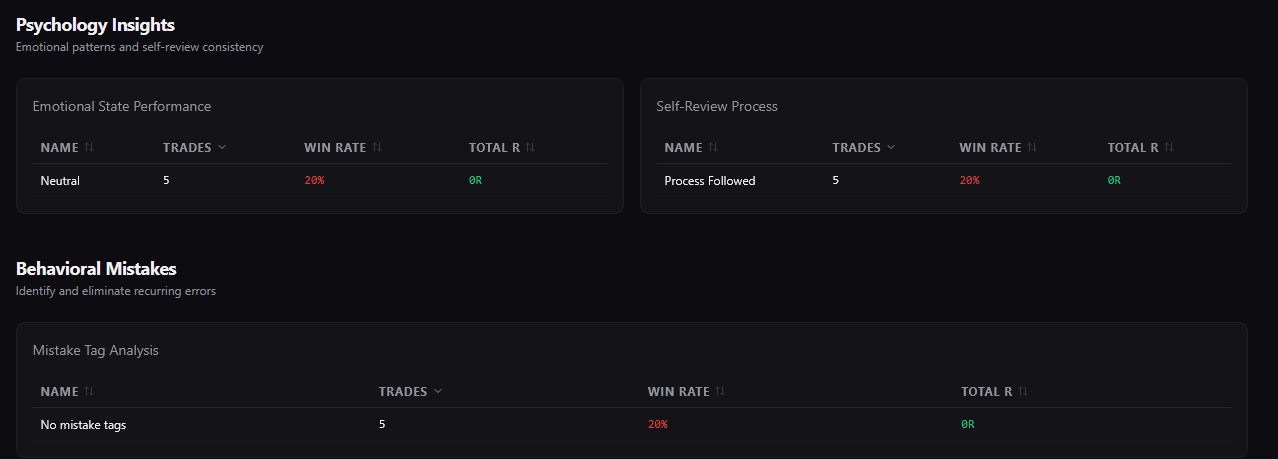
Do not try to solve every emotion during the session. Review patterns weekly.
At the end of the week, ask:
- Which emotion appeared most often before bad trades?
- Which emotion appeared before my best trades?
- What triggered my worst decisions?
- Did I trade worse after losses?
- Did I overtrade when bored?
- Did fear cause early exits?
- What one emotional pattern should I focus on next week?
This turns trading psychology into a practical review process instead of vague self-criticism.
Example Psychology Journal Entry in TradeDoctorAI
| Journal Field | Example Entry |
|---|---|
| Symbol | EUR/USD |
| Setup | Breakout retest |
| Result | -1R |
| Emotion Before Entry | Rushed, FOMO |
| Trigger | Missed the first breakout candle |
| Behavior | Entered before retest confirmation |
| Rule Adherence | Minor rule break |
| Lesson | If I miss the first move, wait for retest or skip the trade. |
This entry is short, but it gives enough context to review behavior later.
How TradeDoctorAI Helps Track Trading Psychology
TradeDoctorAI helps traders connect emotional notes with trade outcomes, risk decisions, and execution quality.
Instead of manually reading through every note, you can use AI analysis to find recurring themes such as:
- “Your rushed trades usually happen after missed moves.”
- “Your biggest losses are connected to frustration after prior losses.”
- “Your calm trades have higher execution scores.”
- “Your early exits often happen when position size is larger than normal.”
- “Your boredom trades mostly occur during low-volume sessions.”
These insights help you build better rules.
For example:
- No trades within 10 minutes after a loss.
- No entries after missed breakouts unless a clean retest forms.
- Reduce size when emotional state is not calm or neutral.
- Stop trading after two emotional rule breaks.
Common Mistakes in Trading Psychology Journals
Mistake #1: Writing “Emotional” Without Details
Do not just write “emotional trade.” Write the specific emotion and trigger.
Mistake #2: Only Tracking Emotions After Losses
Winning trades can be emotional too. Overconfidence, FOMO, and lucky rule-breaking can show up in profitable trades.
Mistake #3: Trying to Eliminate Emotion
The goal is not to become emotionless. The goal is to understand which emotions lead to bad decisions and build rules around them.
Mistake #4: Not Connecting Emotion to Behavior
Emotion matters most when it changes your actions. Track whether it affected entry, exit, size, stop, or trade frequency.
Mistake #5: Never Reviewing Patterns
Logging emotions is useful only if you review them. Weekly review turns emotional notes into trading insight.
Featured Answer: How Do You Track Emotions in a Trading Journal?
Track emotions in a trading journal by recording your emotional state before entry, during the trade, and after exit. Add the trigger, whether the emotion changed your decision, and one lesson. Use simple tags like calm, rushed, fearful, frustrated, bored, overconfident, revenge-minded, or FOMO.
Over time, compare emotional tags with trade quality, risk mistakes, and results to identify patterns.
FAQ
Why should traders track emotions?
Traders should track emotions because fear, frustration, boredom, FOMO, and overconfidence can directly affect entries, exits, position size, stop losses, and trade frequency.
What emotions should I track in my trading journal?
Track emotions such as calm, patient, confident, rushed, fearful, frustrated, bored, overconfident, revenge-minded, hopeful, and FOMO. Keep the labels simple so you can review them easily.
How often should I review trading psychology notes?
Review emotional notes after each session and do a deeper review weekly. Weekly review helps identify repeated emotional triggers and behavior patterns.
Can TradeDoctorAI detect emotional trading?
TradeDoctorAI can help identify emotional trading patterns by analyzing your notes, tags, risk behavior, timing, and trade outcomes. It can highlight repeated issues like revenge trading, FOMO entries, boredom trades, and fear-based exits.
Does emotional trading always cause losses?
No. Some emotional trades win, which is why they are dangerous. A profitable emotional trade can reinforce bad habits. That is why traders should review winners and losers for emotional decision-making.
Final Thoughts: Your Emotions Are Part of the Trade
Your emotions do not make you a bad trader. Ignoring them makes improvement harder.
If fear causes early exits, track it. If frustration causes revenge trades, track it. If boredom causes overtrading, track it. If overconfidence makes you size up too fast, track it.
TradeDoctorAI helps traders bring psychology into the journal instead of leaving it in memory. Use it to record emotional tags, review behavior, identify patterns, and build rules that protect your trading decisions when pressure rises.
The chart shows price. Your psychology journal shows the trader making the decisions.
Related Articles: