
Every serious trader eventually realizes that success in the financial markets is not about predicting the next candlestick. It comes down to understanding your numbers, mastering risk parameters, and eliminating costly behavioral errors.
Among all the performance metrics and risk management principles in trading, few are as critical—or as frequently misunderstood—as profit factor in trading. When tracked properly, it serves as a high-fidelity diagnostic tool for your entire trading strategy.
In this comprehensive guide, we will break down what profit factor in trading is, how to measure it with precision, how pro traders use it to protect their capital, and how you can track it seamlessly using modern trading analytics.
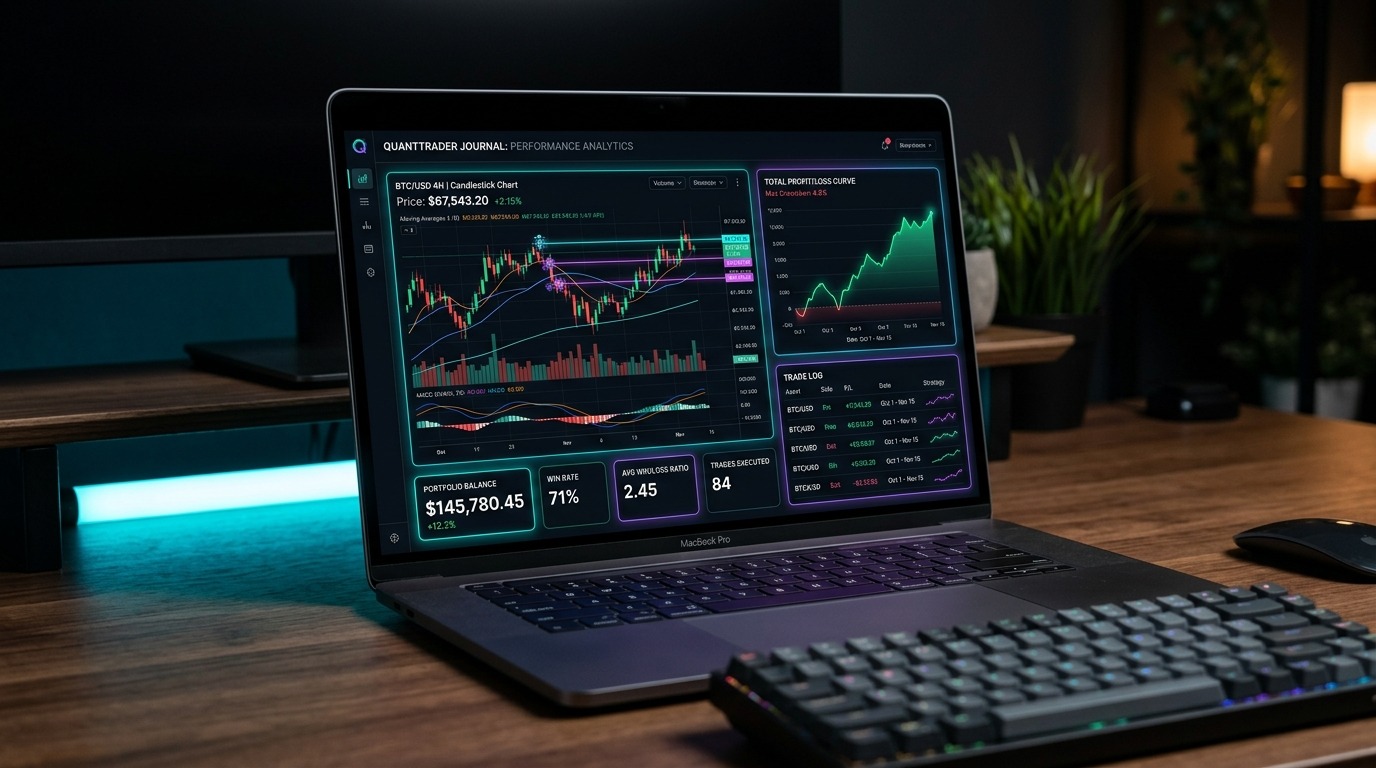
What Is Profit Factor In Trading? (Direct Definition)
Profit Factor In Trading is a key performance and risk metric used by traders to measure the statistical efficiency, reliability, and edge of a trading system over a meaningful sample of trades. Unlike gross profit or simple win rate, it accounts for both the frequency of outcomes and the magnitude of risk taken to generate returns.
Most retail traders obsess over win rate, believing that winning 70% or 80% of trades guarantees profitability. However, professional trading firms and quantitative hedge funds look at risk-adjusted return and expectancy. A high win rate with poor risk management leads to catastrophic drawdowns, while a modest win rate paired with strong profit factor in trading creates a sustainable, compounding account curve.
Why Profit Factor In Trading Is Critical for Trading Longevity
Without tracking profit factor in trading, you are essentially trading blind. You may have winning weeks and losing weeks, but you will not know whether your profits are the result of genuine statistical edge or simply a lucky streak in a forgiving market regime.
Here is why pro traders prioritize profit factor in trading:
- Removes Emotional Bias: Instead of feeling ecstatic after a win or despondent after a loss, it anchors your mindset to long-term mathematical expectancy.
- Flags System Decay Early: If your market regime changes from trending to range-bound, your profit factor in trading will dip long before your account balance suffers fatal damage.
- Enforces Consistent Position Sizing: It directly informs how much risk you can safely take per trade without risking the mathematical risk of ruin.
- Distinguishes Edge from Luck: It reveals whether your results stem from rule discipline or undisciplined gambles that happened to pay off.
As we discussed in our guide on Why You’re Profitable on Demo but Losing on Live: The Psychology Gap, the difference between amateurs and professionals is that professionals treat their trades as data points in a continuous feedback loop.
The Formula: How to Measure Profit Factor In Trading Accurately
To calculate profit factor in trading correctly, you must rely on objective trade records rather than estimates. Here is the standard calculation framework:
| Component | Definition | Why It Matters |
|---|---|---|
| Gross Returns | Total cumulative profit across all winning trades | Reflects upside capture and trend participation |
| Gross Losses | Total cumulative losses across all losing trades | Reveals stop-loss discipline and execution leaks |
| Trade Sample Size | Total number of closed, fully audited trades | Must be at least 30 to 50 trades for statistical significance |
| Risk Multiplier (R) | The planned capital risked per individual trade | Normalizes trades across different instruments and lot sizes |
When you conduct a Trading Psychology Journal — How To Track Emotions Alongside Trades on a weekly basis, recalculating this metric allows you to spot whether your execution is improving or degrading over time.
Comparison: Amateur Approach vs. Professional Approach
Understanding how market participants treat profit factor in trading highlights the massive psychological and technical divide between retail failure and institutional consistency:
| Trait | Amateur Retail Trader | Disciplined Pro Trader |
|---|---|---|
| Primary Focus | Dollar P&L of the last trade | System expectancy and risk-adjusted efficiency |
| Trade Tracking | Casual mental notes or messy spreadsheets | Automated analytics with behavioral tagging |
| Reaction to Losing Trades | Revenge trades or moves stop loss further away | Accepts loss as the necessary cost of business |
| Position Sizing | Arbitrary gut feelings or random lot sizes | Mathematically calculated based on risk tolerance |
| Use of AI Analytics | Ignored or feared | Leveraged to identify blind spots and rule breaks |
3 Common Mistakes Traders Make with Profit Factor In Trading
1. Evaluating Results on Too Small a Sample Size
In probability theory, the Law of Large Numbers dictates that edge only reveals itself across large iterations. Calculating profit factor in trading across only 5 or 10 trades is statistically meaningless; variance and market noise will dominate the results. Aim for a minimum sample of 50 to 100 closed trades before making strategic changes.
2. Failing to Track Execution Quality and Emotions
Numbers tell you what happened, but they do not explain why. A trader might show a poor metric not because their strategy is flawed, but because they took 10 impulsive trades outside their plan during high-volatility news events. Tracking psychological states alongside metrics is essential.
3. Ignoring Slippage, Spread, and Commissions
Gross metrics can be deceptive. A strategy that looks profitable on paper can easily become negative once real-world broker spread, slippage, and swap fees are factored in. Accurate performance analysis must be net of all operational friction.
How TradeDoctor AI Automates Tracking for Profit Factor In Trading
Logging every trade manually, calculating formulas in Excel, and tagging emotional states is exhausting. Most traders abandon manual spreadsheets within two weeks because of the friction involved.
That is why modern traders are transitioning to the What To Write In Your Trading Journal — Entry By Entry Breakdown. With TradeDoctor AI, you can:
- Instant Trade Import: Seamlessly import your trades via CSV, broker sync, or SnapJournal in seconds.
- Automated Metric Computation: Instant calculation of your profit factor in trading, profit factor, win rate, expectancy, and max drawdown without writing a single spreadsheet formula.
- AI Mistake Detection: Automatically flags behavioral errors such as revenge trading, moving stop losses, and over-leveraging before they wipe out your account.
- Interactive Charts & Equity Curves: Visually inspect your performance across different sessions, days of the week, and asset classes to pinpoint your true market edge.
Frequently Asked Questions (FAQ)
What is considered a good benchmark for profit factor in trading?
A good benchmark depends on your trading style (scalping, day trading, or swing trading). Generally, any system that produces a positive mathematical expectancy with controlled drawdowns under 10-15% is considered robust and institutional grade.
Can I calculate profit factor in trading if I trade multiple asset classes?
Yes. By converting your trades into R-multiples (multiples of your planned risk) rather than dollar values, you can compare trades across forex, stocks, crypto, and futures on an identical playing field.
How often should I review my profit factor in trading?
We recommend reviewing high-level performance metrics weekly and conducting an in-depth monthly audit. Daily micro-checking often leads to emotional over-optimization and unnecessary strategy tinkering.
Why do my live trading metrics differ from my backtesting results?
The gap between backtesting and live execution is usually driven by psychology (fear, FOMO, hesitation) and operational realities (slippage, spread widening, and execution delays). A trading journal bridges this exact gap.
How does TradeDoctor AI help improve my profit factor in trading?
TradeDoctor AI diagnoses the specific leaks draining your edge. By isolating which setups, timeframes, or emotional triggers cause your largest losses, you can eliminate negative-expectancy trades and focus purely on what works.
Final Thoughts: Turn Data into Consistent Trading Edge
Mastering profit factor in trading is not just an academic exercise. It is the practical foundation upon which profitable, stress-free trading careers are built. When you stop guessing and start measuring, trading stops being an emotional gamble and becomes a disciplined business.
Ready to discover what your trading data is really telling you? Start journaling with TradeDoctor AI today and let artificial intelligence diagnose your trading habits.